



Click here to get your Fellow Ticket
Click here to get your Non-Fellow Ticket
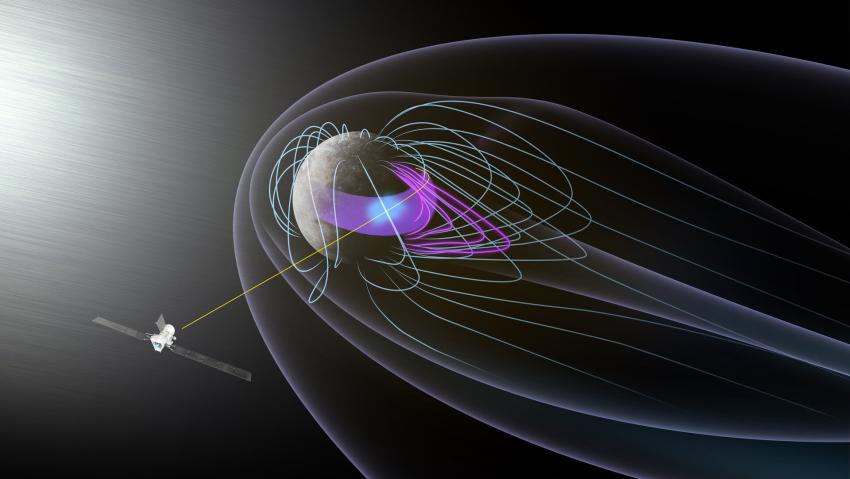
Mercury, being the closest planet to the Sun, is highly influenced by the Sun’s environment, particularly the response of the magnetosphere and its coupling to the surface during solar transient events. Simple changes in the direction of the interplanetary magnetic field produces an instantaneous change in the morphology of the magnetosphere, and therefore, on the distribution of plasma particles within. This response is more intense when showers of solar energetic particles hit the planet, sometimes causing the surface to emit a glow and produce X-rays. This dramatic reaction makes Mercury one of the most dynamics planets in the Solar System, and it is currently the target of the BepiColombo mission, which will arrive at Mercury in November 2026.
As a highly reactive medium to solar activity, it is necessary for the planetary and solar communities to join efforts to prepare for the arrival of BepiColombo in order to provide the current state-of-the-art of the solar wind dynamics at 0.3 AU, the feasibility of forecasting solar transients at such distances, and the holistic response of the Hermean environment to them.
During the meeting, we will be focusing on the solar wind and space weather encountered nearby Mercury’s orbit by MESSENGER, Solar Orbiter and Parker Solar Probe. The initiative aims to bridge gaps between both planetary and solar communities by fostering discussion and collaboration. We encourage contributions from the solar and Mercury’s communities with the goal of getting the most up to date view of Mercury’s space environment state of the art.
Topics to be covered:
(1) Solar wind interaction with Mercury during the high solar activity phase;
(2) The holistic response of the Hermean system to solar events, including the magnetosphere response, and the emission of X-rays from the surface;
(3) Solar wind and solar transient prediction;
(4) Lessons learnt from MESSENGER at Mercury and Solar Orbiter at Mercury distances.
Time | Speaker | Title |
10:30-10:35 | Beatriz Sanchez-Cano | Welcome/Logistics |
BepiColombo and Mercury overview. Chair Beatriz Sanchez-Cano. | ||
10:35-11:50 | Geraint Jones (invited) | BepiColombo: A Mission Update |
11:50-11:05 | Go Murakami (invited) | BepiColombo -the ESA-JAXA joint mission to Mercury- |
11:05-11:20 | Daniel Heyner (invited) | Magnetic Coupling at Mercury: Dynamo, Crustal Conductivity, and Magnetospheric Dynamics |
11:20-11:35 | Emma Bunce (invited) | MIXS overview |
11:35-11:50 | Georgios Nicolaou (invited) | Solar wind in the inner heliosphere: Lessons from Solar Orbiter and synergies with other missions |
11:50-13:00 | Lunch Break | |
Solar influence. Chair Lina Hadid. | ||
13:00-13:15 | Marco Pinto (online) | Solar Energetic Particles at Mercury’s distances |
13:15-13:30 | Gaku Kinoshita | Application of the Housekeeping Particle Monitor onboard BepiColombo/Mio to the Exploration of the Inner Heliosphere and Mercury’s environment |
13:30-13:45 | Ryan Dewey (online) | "Seasonal" change in solar wind characteristics at Mercury |
Planetary responses. Chair Sae Aizawa. | ||
13:45-14:00 | Simon Lindsay | The Mercury Imaging X-ray Spectrometer (MIXS) |
14:00-14:15 | Jim Raines | Mercury’s He exosphere generated by CME impact. |
14:15-14:30 | Léa Griton | Measuring electrons in the Hermean environment |
14:30-14:50 | Break | |
14:50-15:05 | Mathias Rojo | Third Mercury flyby by BepiColombo |
15:05-15:20 | David Rees | The Mercury Sodium Atmosphere Spectral Imager (MSASI) |
15:20-15:35 | Daragh M. Hollman | Prediction of Mercury plasma regions |